


An ankle sprain happens in a moment: an uneven pavement, landing on someone else's foot, stepping off a kerb. Because most sprains get better quickly, we often brush it off with "it'll be fine". But a sprain that isn't fully rehabilitated is exactly the one that likes to come back.
In short
- Most sprains affect the ligaments on the outside of the ankle.
- If you can't take four steps or the bone itself is tender, you need a doctor's check.
- Movement and gradual loading help more than long periods of rest.
- Balance exercises reduce the chance of another sprain by about a third.
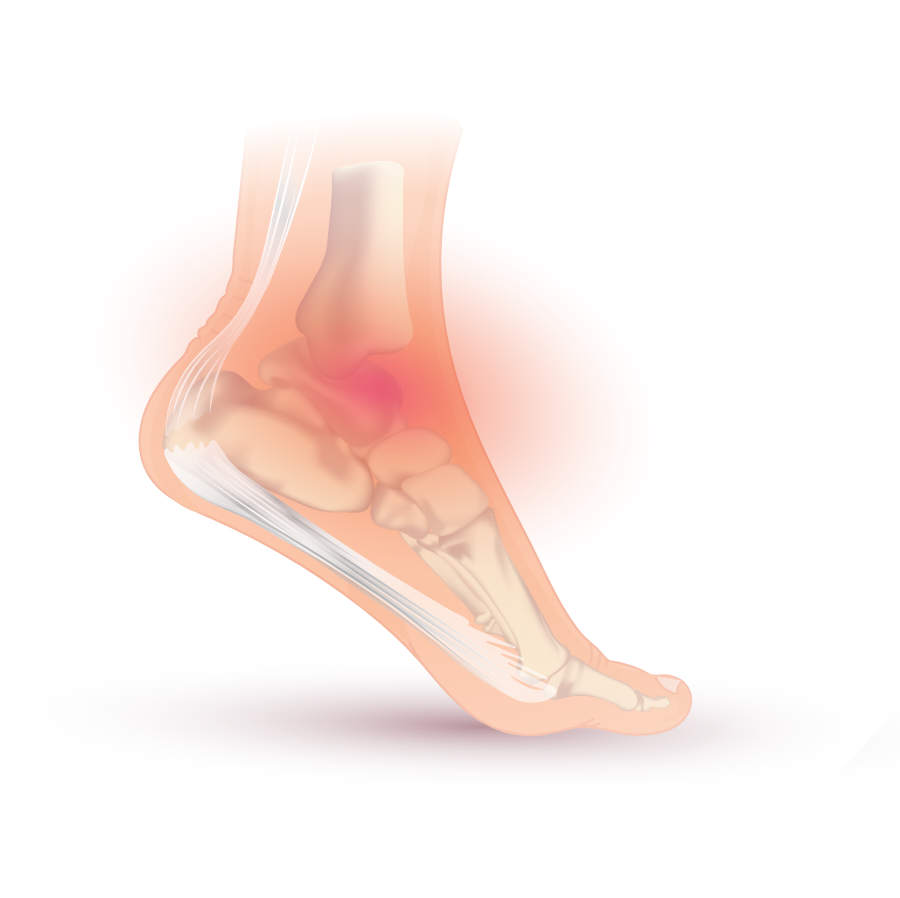
How common is an ankle sprain?
Very. A review of studies found that a sprain on the outside of the ankle is the most common type. It is more frequent in women and children, and most sprains happen in indoor and court sports such as basketball, volleyball and handball (Source: Doherty et al., Sports Medicine, 2014).
Is it broken? When you need an X-ray
Doctors use the Ottawa ankle rules. An X-ray is needed if you can't take four steps right after the injury and at the examination, or if pressing on certain parts of the bone hurts: the back edge or tip of the outer or inner ankle bone, the base of the fifth metatarsal, or the navicular bone on the inside of the foot. The rules almost reliably rule out a fracture and save 30 to 40% of unnecessary X-rays (Source: Bachmann et al., BMJ, 2003).
What to do in the first days
- Protect the ankle for the first few days, for example with a brace or taping, and raise it when you sit.
- Walk as much as the pain allows. Guidelines recommend functional care with support and exercise rather than long-term immobilisation (Source: Vuurberg et al., BJSM, 2018).
- Be careful with anti-inflammatory painkillers. They can reduce pain and swelling, but may also slow natural healing (Source: Vuurberg et al., BJSM, 2018).
- Start gentle ankle movement: circles, drawing letters with your toes.
Why sprains keep coming back
After a sprain, it isn't just the ligament that is affected, but also your sense of ankle position and your balance. In people after a first sprain, being unable to land on one leg or do a two-footed jump two weeks after the injury was linked to developing chronic ankle instability a year later (Source: Doherty et al., AJSM, 2016).
Balance is the best prevention
In athletes after a sprain, an 8-week home balance programme led to 37% fewer repeat sprains than no programme (Source: Hupperets et al., BMJ, 2009). The exercises need no equipment and take a few minutes a day.
- Stand on one leg for 30 seconds, then with your eyes closed.
- Stand on one leg on a cushion or folded towel.
- Stand on one leg while passing a ball or reaching to touch the floor in different directions.
- When it's pain-free: hops and landings on one leg.
For ankle and foot exercises, see also Where does it hurt?.
When to see a doctor straight away
- See a doctor if you can't take four steps, if the ankle looks bent or deformed, if pressing on the bone hurts, if your foot feels numb, or if pain and swelling aren't improving after one to two weeks.
How we help at Center ZATE
We check your ankle's mobility, strength and balance, and build a gradual programme from your first steps to jumps and changes of direction. Before you return to sport, we test single-leg landings to lower the chance of another sprain.
Does your ankle often "give way"? Book an assessment and we'll build a programme to make it reliable again.
Sources
- Doherty C et al. The incidence and prevalence of ankle sprain injury: a systematic review and meta-analysis. Sports Medicine, 2014.
- Bachmann LM et al. Accuracy of Ottawa ankle rules to exclude fractures of the ankle and mid-foot: systematic review. BMJ, 2003.
- Vuurberg G et al. Diagnosis, treatment and prevention of ankle sprains: update of an evidence-based clinical guideline. BJSM, 2018.
- Doherty C et al. Recovery from a first-time lateral ankle sprain and the predictors of chronic ankle instability. AJSM, 2016.
- Hupperets MD et al. Effect of unsupervised home based proprioceptive training on recurrences of ankle sprain. BMJ, 2009.
This article is for information only and does not replace an examination by a doctor.
