


The knee carries a lot: walking, stairs, squats, running and jumping. When it starts to hurt, we quickly wonder whether something is "torn" or "worn out". Often the answer is simpler, and more encouraging. Where exactly it hurts already tells us a lot.
In short
- The location of the pain points us to the most likely cause.
- Pain around the kneecap (runner's knee) is very common, including in young people.
- Recreational running generally doesn't harm your knees.
- Strength exercises for the knee and hip help with most problems, including wear and tear.
- A hot, swollen knee with fever, or a knee that can't take your weight, needs a doctor.
Where does it hurt? The location tells you a lot
- At the front, around or behind the kneecap: most often patellofemoral pain, or "runner's knee". It hurts on stairs, in squats, running downhill and after sitting for a long time.
- Just below the kneecap: often an overloaded patellar tendon ("jumper's knee"), typical in jumping sports.
- On the outside of the knee: in runners and cyclists, often irritation of the iliotibial band.
- On the inside or deep in the knee, with catching: this may be the meniscus. Read more in our article Meniscus wear and tear.
- The whole knee, morning stiffness, after 50: often joint wear and tear (osteoarthritis).
- After a twist or fall, with quick swelling: a possible ligament or meniscus injury. See a doctor first.
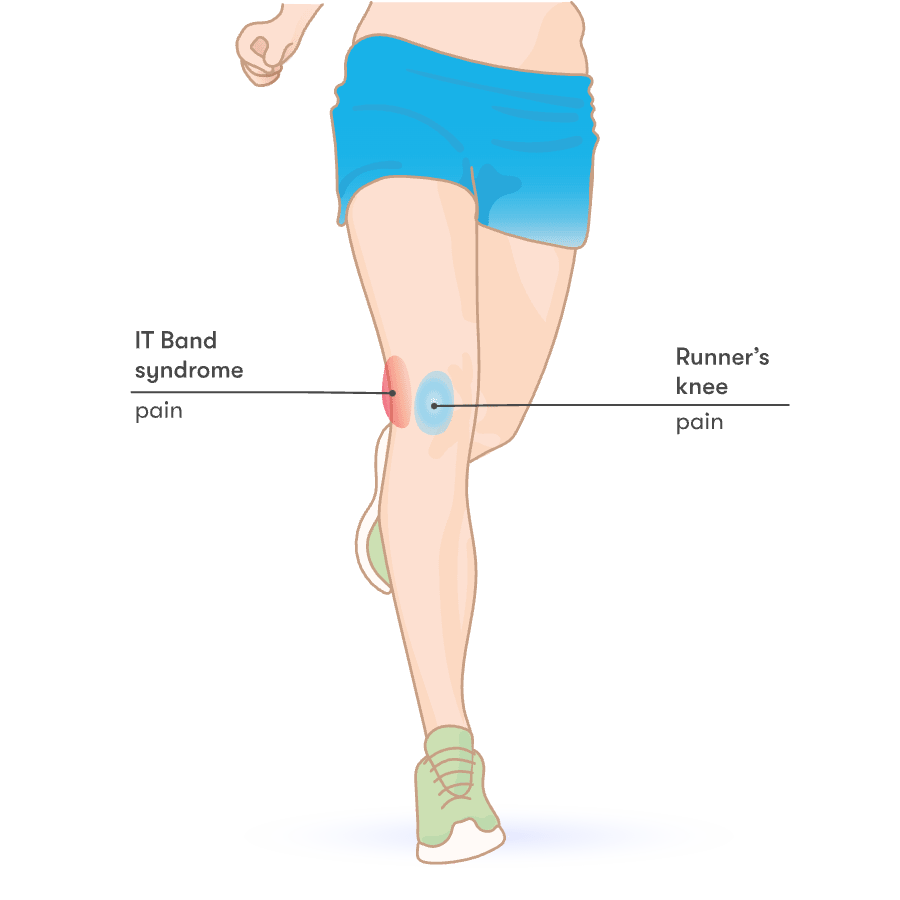
Runner's knee: common, but very manageable
Pain around the kneecap is one of the most common knee problems. A review of studies found that 22.7% of people in the general population and 28.9% of adolescents experience it within a year (Source: Smith et al., PLoS One, 2018).
The good news: exercise helps. In people with patellofemoral pain, exercise reduced pain and improved function, and hip and knee exercises together may work better than knee exercises alone. The quality of evidence is low, but the results are consistent (Source: van der Heijden et al., Cochrane, 2015).
Does running harm your knees?
This is one of the most common myths. A review of studies found osteoarthritis of the hip or knee in 3.5% of recreational runners, 10.2% of inactive people, and 13.3% of competitive runners with very high training volumes (Source: Alentorn-Geli et al., JOSPT, 2017). So moderate running is more of a friend than an enemy to your knees.
What about knee wear and tear?
With joint wear and tear too, exercise is the first step. In people with knee osteoarthritis, exercise reduced pain and improved function, with an effect comparable to anti-inflammatory painkillers (Source: Fransen et al., Cochrane, 2015).
What you can do yourself
- Not complete rest, but adjustment. For a few weeks, reduce whatever hurts most (deep squats, stairs, downhill running) and keep the rest of your movement.
- A practical rule: mild pain during exercise (up to about 3 out of 10) that settles by the next day is usually acceptable.
- Strengthen your thigh and hip: for example, standing up from a chair, glute bridges and side leg raises.
- Build back up gradually. Increase your running or jumping in steps, not all at once.
For knee and hip exercises filmed by our team, see Where does it hurt?.
When to see a doctor straight away
- Go to A&E as soon as possibleif your knee is hot, red and swollen and you have a fever, or if your calf suddenly becomes swollen, painful and warm.
- See a doctor if you can't put weight on your leg after an injury, if the knee swelled up straight away, if it has "locked" and you can't straighten it, or if it gives way under load.
How we help at Center ZATE
We look at the knee, but also the hip, the foot and how you move, because the cause is often not just in the knee. With manual care we ease the pain, then we make an exercise plan and a gradual return to running, sport or everyday activities.
Is your knee holding you back from running, stairs or sport? Book an assessment and we'll make a plan to get you moving again.
Sources
- Smith BE et al. Incidence and prevalence of patellofemoral pain: a systematic review and meta-analysis. PLoS One, 2018.
- van der Heijden RA et al. Exercise for treating patellofemoral pain syndrome. Cochrane, 2015.
- Alentorn-Geli E et al. The association of recreational and competitive running with hip and knee osteoarthritis. JOSPT, 2017.
- Fransen M et al. Exercise for osteoarthritis of the knee. Cochrane, 2015.
This article is for information only and does not replace an examination by a doctor.
