


Your MRI report says "degenerative meniscus tear", and the first thought is often surgery. Research from recent years is very clear on this: for most people with a worn meniscus, exercise is just as good a choice as an operation, and sometimes even better.
In short
- Meniscus wear and tear is very common after 40, even in people without pain.
- In research, keyhole surgery for a worn meniscus was no better than a sham procedure.
- Exercise gave the same results as surgery, plus better thigh strength.
- A knee that locks and won't straighten needs a doctor's check.
What is the meniscus?
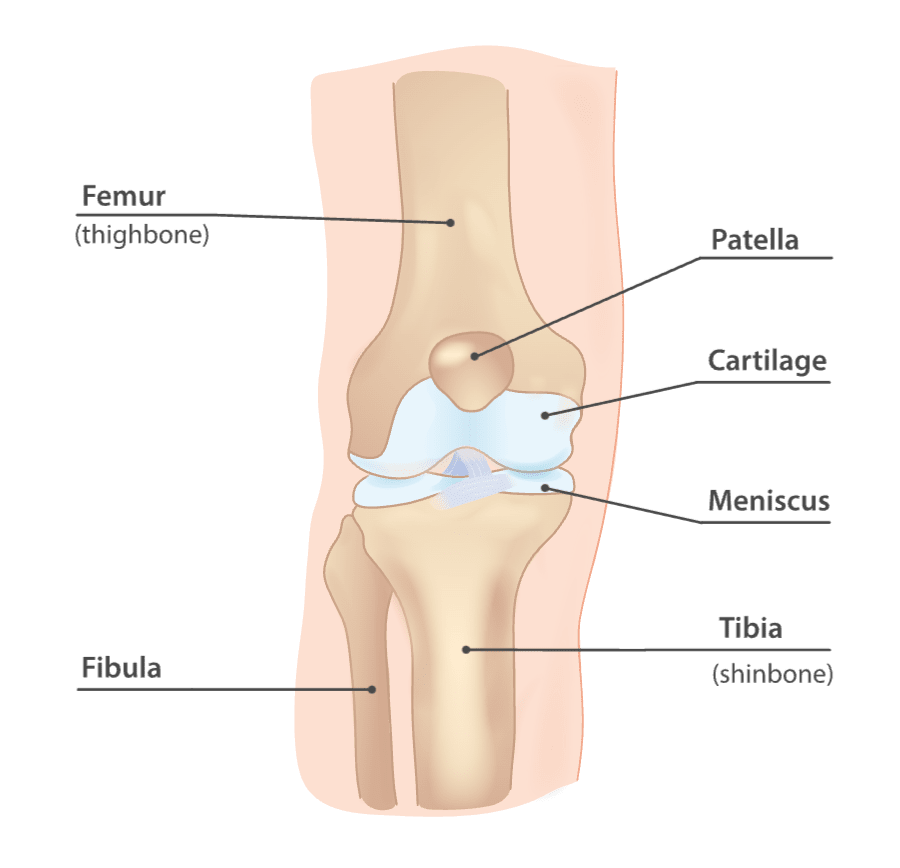
Each knee has two menisci, an inner and an outer one. They are crescent-shaped cushions that absorb load and help the thigh bone and shin bone fit together smoothly.
Wear and tear or injury?
- Injury (traumatic tear): happens with a sudden twist, often in younger people and athletes. The knee often swells the same day.
- Wear and tear (degenerative change): develops gradually, usually after 40, often without any clear event. It is part of the knee's natural ageing.
How common is a worn meniscus?
Very. In people aged 50 to 90, MRI showed a meniscus tear in anywhere from 19% of women aged 50 to 59 to 56% of men aged 70 to 90. As many as 61% of people with a meniscus tear had no knee pain or stiffness at all in the previous month (Source: Englund et al., NEJM, 2008).
This means the scan doesn't always explain why your knee hurts. What matters more is how your knee works and what is holding you back.
Surgery or exercise?
In people with a worn inner meniscus and no joint osteoarthritis, those who had part of the meniscus removed by keyhole surgery did no better than those who had only a sham procedure (Source: Sihvonen et al., NEJM, 2013).
In middle-aged people with a worn meniscus, a 12-week supervised exercise programme gave the same results as surgery after two years, and after three months those who exercised had stronger thigh muscles (Source: Kise et al., BMJ, 2016). Based on this and other research, international guidelines advise against keyhole surgery for most people with degenerative knee problems (Source: Siemieniuk et al., BMJ, 2017).
Surgery can make sense for a fresh injury in younger people, or when the knee locks and you can't straighten it. An orthopaedic surgeon decides this.
What helps
- Strength exercises for the thigh and hip muscles, built up gradually.
- Balance and knee control, for example standing on one leg and slow squats to a comfortable depth.
- Movement that nourishes the knee: cycling, swimming, walking.
- Patience: symptoms with wear and tear come and go. A worse day doesn't mean your knee has got worse.
When to see a doctor straight away
- See a doctor if your knee "locks" and you can't straighten it, if it swells up a lot after a twist, if you can't put weight on it, or if it is hot and red.
How we help at Center ZATE
We go through your scan report together and explain it in plain language. We check how your knee works and put together a supervised strength and stability programme. If we think you need to see an orthopaedic surgeon, we'll tell you.
Have an MRI showing meniscus wear and not sure what to do next? Book an assessment and we'll make a plan together.
Sources
- Englund M et al. Incidental meniscal findings on knee MRI in middle-aged and elderly persons. NEJM, 2008.
- Sihvonen R et al. Arthroscopic partial meniscectomy versus sham surgery for a degenerative meniscal tear. NEJM, 2013.
- Kise NJ et al. BMJ, 2016;354:i3740 (randomised controlled trial, degenerative meniscal tear).
- Siemieniuk RAC et al. Arthroscopic surgery for degenerative knee arthritis and meniscal tears: a clinical practice guideline. BMJ, 2017.
This article is for information only and does not replace an examination by a doctor.
